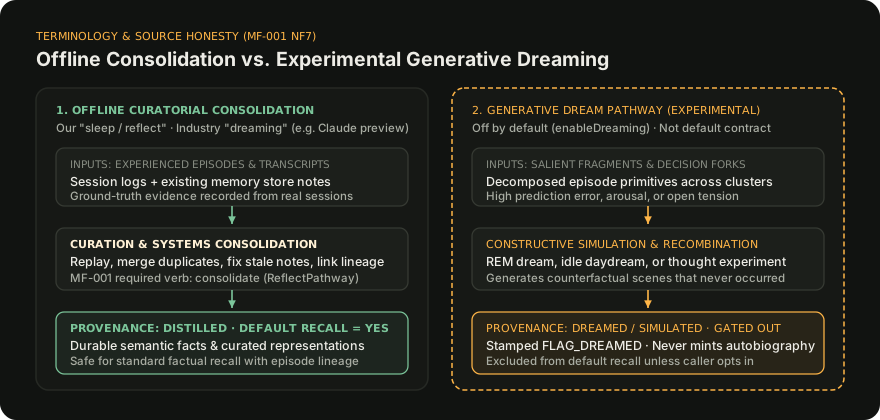
Agent memory engineering is converging on a shared realization: capturing everything inside an active conversation turn is not enough. What an agent records in the moment is local, noisy, and incomplete; making memory reliable over weeks or months requires offline background work between sessions.
As that conversation has matured, the word "dreaming" has moved to the center of the vocabulary—most visibly in Anthropic's recent engineering write-up on agent memory and the Dreams research preview for Claude Managed Agents. Across the broader cognitive-architecture literature, however, "dreaming" is used to name two very different operations:
- Offline curatorial consolidation: reviewing past session transcripts and notes to fix mistakes, merge duplicates, and reorganize verified knowledge.
- Generative counterfactual recombination: decomposing fragments of past episodes into hypothetical scenes or thought experiments that never actually happened.
Both mechanisms are genuinely useful. Conflating them inside the same storage contract is dangerous. Here is how the field is talking about dreaming right now, what we treat as sleep/reflect consolidation across Memory Fundamentals, Spector, and ebbmem, and why our generative Dream pathway is explicitly experimental and provenance-gated.
1. How the Current Conversation Uses “Dreaming”: Offline Curation
In their November 6, 2026 engineering post, The components of agent memory, Anthropic lays out a clear division of labor between fast in-session memory capture and offline background organization. Citing sleep-time compute research from Letta and UC Berkeley as related work, they describe dreaming as an offline pass between sessions where a model reflects on transcripts and an existing memory store to:
- Correct in-session mistakes against ground-truth logs: When an agent writes notes mid-task, a mistaken inference can persist into future sessions. In Anthropic's Pokémon Red evaluation, an uncorrected landmark note near Mt. Moon caused the agent to loop repeatedly off a one-way ledge; checking the note against the session transcript during an offline dreaming pass caught and fixed the error.
- Build navigational representations: Rather than relying on search alone, offline passes can maintain linked knowledge structures such as wikis. Evaluating Opus 5 across 2 to 128 sessions over an internal corpus of roughly 350,000 files (~420M tokens), Anthropic reported that wiki-only answers rose from 13% to 48% of graded criteria, while combining search with the wiki rose from 54% to 61% (versus 53% for search alone) and saved roughly 20,000 tokens per question. On a 24-question multi-document merger evaluation alongside the Harvey LAB benchmark, consulting the wiki reached 87% versus 73% for search alone—while single-document lookup tasks showed no clear gain, and one unconstrained wiki grew larger than the raw source files.
- Curate the top of the memory hierarchy: Keeping preemptively injected context compact (for example, keeping an index layer small while moving details into linked pages) avoids burning context tokens and diluting instruction adherence.
On the product side, Dreams in Claude Managed Agents exposes this workflow as a research preview. A dream runs as an asynchronous job over a pre-existing memory store plus 1 to 100 session transcripts, optionally guided by high-level synthesis instructions. Notably, the job never mutates or deletes its inputs: it writes a new, separate output memory store so developers can inspect the reorganized notes—or discard them—before attaching the store to future sessions.
That non-destructive clone-and-curate design is thoughtful systems engineering. Notice, too, what the operation is doing: it is verifying, deduplicating, reconciling contradictions, and distilling real session evidence into cleaner knowledge.
2. Why We Separate Sleep Consolidation from Generative Dreaming
In our architecture—defined in the open Memory Fundamentals specification (MF-001), implemented in our open-source memory engine Spector, and carried into our cloud memory engine ebbmem—we draw a strict boundary between curatorial consolidation and generative dreaming.
| Architectural Dimension | Sleep / Reflect Consolidation (consolidate) |
Generative Dream Pathway (dream / simulate) |
|---|---|---|
| Primary goal | Distill repeated or verified episodes into stable semantic/procedural knowledge; prune noise | Recombine fragments offline or run constrained thought experiments to surface candidate hypotheses |
| MF-001 status | Required core conformance verb (remember, recall, consolidate, forget) |
Optional verb; engine remains fully conformant if omitted |
| Contract status | Core memory lifecycle | Explicitly experimental; off by default behind opt-in configuration |
| Trace provenance | distilled (with lineage links back to experienced episodes per NF2 / M8) |
simulated (DREAMED or THOUGHT_EXPERIMENT in Spector; FLAG_DREAMED / FLAG_SIMULATED) |
Default recall visibility |
Included in normal recall alongside experienced traces |
Hard-gated out (allow_simulated = false by default) unless caller explicitly opts in |
What Anthropic's post calls "dreaming" maps closely to what we call sleep consolidation or reflection (consolidate in MF-001; ReflectPathway in Spector; reflect in ebbmem). During consolidation, time-stamped episodic observations ("Asked for metric units" in Session A, "Convert payload weights to kg" in Session B) are clustered, deduplicated, and lifted into higher-stability semantic knowledge ("Prefers metric units", S↑) while preserving explicit provenance edges back to the source episodes. In ebbmem, structural consolidation runs deterministically on CPU by default, with language-model prose synthesis (reflect.require_llm: true) strictly opt-in—as detailed in Memory Without an LLM in the Loop.
Why keep the word dream separate from consolidate? Because biological dreaming—and constructive episodic simulation in cognitive science (Schacter & Addis, 2007; Hoel, 2021)—does something beyond tidying up yesterday's notes. It takes fragments from separate experiences and recombines them into scenes that never actually occurred.
3. Inside Spector’s Experimental Dream Pathway
In Spector, our open-source reference engine, the Dream pathway (documented alongside Spector's Experimental Pathways) explores that constructive, hypothesis-generating side of cognition.
When an engineering team explicitly enables enableDreaming in Spector for research or exploratory workflows, the constructive engine operates across three temperature and constraint regimes:
- REM Dream (high temperature, weak constraints): Offline exploratory recombination across distant episodic clusters that share relational or affective structure, testing novel cross-domain pairings.
- Daydream (moderate temperature, narrative continuity constraints): Idle-period associative wandering over unresolved open loops and recent context.
- Thought Experiment (low temperature, strict policy constraints): Deliberate counterfactual probing at decision forks (
THOUGHT_EXPERIMENT).
Rather than dumping synthetic stories into the agent's factual memory, the pipeline decomposes salient seed episodes into typed primitives, tests candidate combinations for coherence and utility, discards incoherent noise (applying negative Hebbian weight adjustments so unproductive pairings are not repeated), logs raw runs to an isolated off-heap Dream Journal audit store outside normal vector indexes, and keeps only structural candidate residue.
4. Source Honesty (NF7): Why Simulated Residue Must Never Masquerade as Fact
The central engineering hazard of any generative memory pathway is confabulation—known in psychology as a source-monitoring error. If an agent speculates offline that "Customer X might be planning a migration to Region EU-West" and stores that hypothesis in the same untyped collection as "Customer X confirmed their production cluster is in US-East," the next session's semantic search will retrieve both records side by side. One turn later, the agent states its own offline speculation as a verified customer commitment.
Memory Fundamentals (MF-001) prevents this at the data-model level through Normal Form 7 (NF7 — Source Honesty):
- Every durable trace carries a closed provenance tag in
{experienced, distilled, simulated, rehearsed}. - Only
remembercreatesexperiencedtraces. Offlinedreamandsimulateoperations can write at mostsimulatedtraces, and no operation in the algebra can ever promote asimulatedtrace into episodicexperiencedautobiography. - Default
recallhard-gatessimulatedtraces. In MF-001, cues default toallow_simulated = false. In Spector's binary engram header, dreamed and simulated records are stamped at the byte level (FLAG_DREAMED/FLAG_SIMULATEDand provenanceDREAMEDorTHOUGHT_EXPERIMENT), and the retrieval gate filters them out of factual queries automatically unless the caller explicitly asks for hypotheses or creative exploration.
For a deeper walkthrough of how provenance tags interact with retrieval strength (D), storage strength (S), importance, valence, and arousal on every trace, see Inside the Engram Header: Cognitive Parameters and Source Honesty for AI Agents.
5. What This Means for ebbmem Builders Today
Spector is our open-source memory engine; ebbmem is our cloud memory engine built on the same principles and Memory Fundamentals.
If you are building production agents today, the practical takeaway is straightforward:
- Use consolidation (
reflect), decay, and verifiable erasure as your production workhorses. Keeping long-horizon agent memory accurate depends first on fast deterministic encoding, spaced reinforcement (S↑), background consolidation of real episodes into semantic facts with lineage, and physical byte-zeroing deletion when data must be forgotten—covered in Why Agent Memory Needs a Delete Button. - Check what "dreaming" means in whichever stack you evaluate. When a platform describes dreaming as offline transcript verification, deduplication, and wiki curation (as in Claude Managed Agents' Dreams research preview), evaluate its compute cost, latency between sessions, and how errors or deletions propagate from transcripts to curated stores. When a system performs constructive or counterfactual generation (as in Spector's experimental
enableDreamingpathway), verify that synthetic traces carry immutable provenance flags and are gated out of default factual recall. - Treat generative dreaming as opt-in exploration, not a default contract. Imagination is valuable when an agent knows it is imagining—and a liability the moment it forgets.